



How to Sell and Successfully Launch Your Retirement
Many business owners are emotionally attached to their businesses, and it is easy to understand why. Typically, business owners invest not only a considerable amount of time and money into their business, but a good bit of themselves as well. Owning and operating a business often becomes part of one’s identity. However, the fact is that no one will work forever, as retirement eventually comes for almost every business owner. With this in mind, it is important to prepare for selling your business well in advance.
Table of Contents:
Brokerage professionals can take your knowledge regarding your business and use it to help you frame your business in the best possible light. Your expertise in your business can also help a broker find ways to improve your business so that it is more attractive to potential buyers. With all of this in mind, let’s turn our attention to the key steps you should take when preparing to sell your business and transition into retirement.
Select Your Second-in-Command
Any savvy buyer will want to know that the business is well supported by a capable team. Buyers rightfully worry about having a smooth transition period, and nothing helps dispel those fears like having a proven and capable second-in-command standing by. When selecting this important individual, it is important that you pick someone who understands how your business works and is a proven asset to its operation.
Automate, Automate, and Automate
Buyers can be intimidated by taking control of a business. Having a proven second-in-command ready to assist is one smart step. Automating as much as possible is yet another prudent move. In short, you want your prospective new buyer to feel more confident about buying and operating your business.
Make a “Smooth Transition” List
As the seller, you have the critically important job of removing buyers’ fears. When you boost their confidence that they can successfully run your business, you increase the odds that your sale will go smoothly. Making a smooth transition list, which includes all the steps that you can take to improve the odds of a buyer being successful, is a smart investment of your time and effort.
A good transition list will include information about how to work with key customers, employees and vendors. You want to ensure that your customers, employees, and vendors understand that a sale will take place, but also understand that the process will be smooth and trouble-free. Whether large or small, take any steps that you can to show buyers that the transition will be well-received.
The average business owner has, in fact, never sold a business before and is unprepared for this very complex process. Since the process of buying or selling a business is a very complicated one, they should strongly consider working with an experienced Business Broker or M&A Advisor who can help guide them through the process. Brokerage professionals are experts at buying and selling businesses. They understand what both buyers and sellers want and need. As a result, they can help you take the necessary steps to get your business ready to be sold.
Copyright: Business Brokerage Press, Inc.
The post How to Sell and Successfully Launch Your Retirement appeared first on Deal Studio – Automate, accelerate and elevate your deal making.

The Psychology of Selling – Are You Sure You’re Ready?
More than likely, selling your business is one of the biggest decisions of your life. Unless you own a business, it is impossible to understand just how all-encompassing of a process it can be. With that stated, it is important for business owners to step back and seriously reflect on whether or not they are truly ready to sell. The psychological aspects of selling are not trivial. Various aspects must be taken into consideration before initiating the process to sell.
Table of Contents:
There are many reasons why it is vital to step back and think about whether or not you are really ready to sell your business. Far too many business owners believe they are ready to sell, only to discover (much too late) that an executed sale is not optimal for their plans.
Selling When There is No Other Choice
Selling a business because there is no other choice, such as situations concerning failing health, personal issues or problems with a business partner, isn’t a true choice at all. In this situation, the psychology of selling is essentially irrelevant, as you have one option, namely, to sell.
The Case of Burnout
In other cases, owners eventually hit a brick wall and have no choice but to consider selling. As burnout sets in, owners may feel that the time is right to “hang up their hat” and put their business up for sale. However, as the process evolves, even those experiencing some level of burnout can discover that they are not emotionally or psychologically ready to sell. In many cases, people make this realization only once it is too late.
Take the Time for Self-Reflection
Quite often, a company becomes interwoven into a business owner’s sense of self, sense of place in the world and even, to an extent, sense of self-worth and identity. When business owners are unaware of this fact, it can be something of a shock to their system to begin the sales process. Many people simply are unaware of the strong hold that their business has on them.
Owners need to invest some time in self-reflection and ask four key questions: Do I really want to sell? If the answer is yes, then why do I want to sell? Will I regret selling once my business is sold? What will I do after I have sold my business? Answering these questions involves far more than evaluating your business. They also involve diving into emotional issues that could be central to your future.
Are You Really Ready to Sell?
One of the best ways of determining whether you are ready to sell, and preparing your business for that potential sale, is to work with a business broker or M&A advisor. Business brokers are experts at helping business owners deal with every aspect of the process of selling a business. They can act as experienced guides that can use that experience and expertise to help you determine if you are truly ready to sell.
If it turns out that you are indeed ready to sell, a brokerage professional can help you prepare so that you can achieve the best price possible once your business hits the market.
Copyright: Business Brokerage Press, Inc.
The post The Psychology of Selling – Are You Sure You’re Ready? appeared first on Deal Studio – Automate, accelerate and elevate your deal making.

John Warrilow’s The Art of Selling Your Business
John Warrilow is the founder of The Value Builder System and an accomplished author. While not a business broker himself, Warrilow has gathered considerable knowledge and expertise on the industry. His previous book, Built to Sell, was listed as one of the best business books of 2011. In this article, we will explore some of the key points in Warrilow’s latest book, which is entitled The Art of Selling Your Business: Winning Strategies and Secret Hacks for Exiting on Top. This book was released on January 12th, 2021, and is proving to be invaluable for business owners.
Table of Contents:
Selling When the Time Is Right
One key focal point of the book is that business owners should skip trying to find the perfect “magical time” to sell their business. Additionally, Warrilow notes, “I make the strong recommendation in the book that the best time to sell your company is not during some mysterious macroeconomic environment. It is when someone is willing to buy it, and you get an offer. And that is because at that point, you’re in the position of strength.”
The DIY Approach
This book reinforces the fact that business owners truly need to work with an intermediary if they are to achieve optimal results. Warrilow even includes his six reasons why every business owner should hire a business broker or M&A advisor.
Many business owners think that they can simply handle selling their business on their own. But the simple fact is that business owners usually have no experience in selling a business. Add this to the fact that selling their business is likely to be the most important financial decision the business owner ever makes, and it quickly becomes clear that business owners are doing themselves a considerable disservice when they opt to handle everything on their own.
A Business Broker vs. A Lawyer
As Warrilow points out, oftentimes, business owners think that rather than working with a business broker or M&A advisor, they can turn to a trusted lawyer who has served them in the past. But this thinking is flawed when it comes to successfully selling a business. As Warrilow states, “a lawyer, almost by default, is going to be very conservative as everything exposes a lawyer to risk. And that is why using a traditional attorney is almost always a mistake.”
If you are planning to sell your business now or in the future, a book like Warrilow’s The Art of Selling Your Business: Winning Strategies and Secret Hacks for Exiting on Top can serve as a uniquely valuable tool in your toolbox.
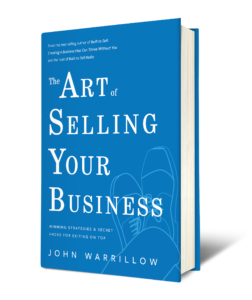
Copyright: Business Brokerage Press, Inc.
The post John Warrilow’s The Art of Selling Your Business appeared first on Deal Studio – Automate, accelerate and elevate your deal making.

The Importance of Owner Flexibility
You shouldn’t expect to sell your company overnight. For every company that sells quickly, there are a hundred that take many months or even years to sell. Having the correct mindset and understanding of what you must do ahead of time to prepare for the sale of your company will help you avoid a range of headaches and dramatically increase your overall chances of success.
First, and arguably most importantly, you must have the right frame of mind. Flexibility is a key attribute for any business owner looking to sell his or her business. There are many variables involved in selling a business, and that means much can go wrong. An inflexible owner can even irritate prospective buyers and inadvertently sabotage what could have otherwise been a workable deal.
Table of Contents:
Be Flexible on Price
A key part of being flexible is to be ready and willing to accept a lower price. There are many reasons why business owners may fail to achieve the price they want for their business. These factors range from lack of management depth and lack of geographical distribution to an overreliance on a handful of customers or key clients. Of course, one way to address this problem is to work with a business broker or M&A advisor in advance, so that such price issues are minimized or eliminated.
Be Prepared to Compromise
In the process of selling your business, you may want to achieve confidentiality and sell your business quickly and for the price you want. However, the fact is that most sellers find that it is possible to have confidentiality, speed, and the price you want, but not all three. Ultimately, you’ll have to pick two of the three variables that are most important to you.
Be Patient
A third way in which business owner flexibility can boost the chances of success is to embrace the virtue of patience. By accepting the fact that businesses can “sit on the shelf” for a considerable period of time, you are shifting your expectations. This realization can help reduce your stress level. The fact is that stressed-out owners are far more likely to make mistakes.
Sometimes Losing is Really Winning
A fourth way in which business owners should be flexible is realizing that you and your lawyer will not win every single fight. There will be many points of contention, and a smart dealmaker realizes that it is often better to have a good deal than a perfect deal. You may have to make sacrifices in order to sell your company. Simply stated, you shouldn’t expect the other side to lose every point.
At the end of the day, a savvy business owner is one who never loses sight of the final goal. Your goal is to sell your business. Seeing the situation from the buyer’s perspective will help you make better decisions on how you present your business and interact with prospective buyers. Maintaining a flexible attitude with prospective buyers helps to position you as a reasonable person who wants to make a deal. Goodwill can go a long way when obstacles do arise.
Copyright: Business Brokerage Press, Inc.
The post The Importance of Owner Flexibility appeared first on Deal Studio – Automate, accelerate and elevate your deal making.

How to Optimize Your Chances of Selling Your Business
The simple fact is that selling your business is likely to be the single most important financial decision you’ll ever make. With this important fact in mind, you must prepare far in advance. Let’s dive in and take a look at some of the key items you’ll want to check off your list before placing your business on the market.
Table of Contents:
- Think About Legalities
- Deal with Serious Buyers
- Be Flexible on Price
- Improving Your Chances for Success
Think About Legalities
When it comes to selling a business, legal issues should be at the forefront of your thoughts; after all, selling your business does involve the creation and execution of a complex and detailed legal agreement. There are many times in life where it is possible to cut corners, but hiring a good lawyer or law firm is not one of those times. Moreover, you’ll want to settle all litigation, environmental issues or other issues that could potentially derail a sale.
Deal with Serious Buyers
Working with a good business broker or M&A advisor is an essential part of the selling process, as these professionals will help you to weed out “window shoppers” as well as prospective buyers who are simply not a good fit for your business. Any serious buyer should be willing to submit a Letter of Intent. Everyone should be on the same page as far as price and terms as well as what assets and liabilities are to be assumed. This second point reinforces the first point. It is essential to have an experienced lawyer helping you through various aspects of the sales process.
Be Flexible on Price
You should also be prepared to accept a lower price than you might ideally want. There are many reasons that this may occur, ranging from a lack of management depth and a lack of geographical distribution to a dependence on a limited number of clients. Reliance on a small number of customers and/or clients can give potential buyers pause, as it could raise concerns regarding the stability of your business. Addressing these issues years before placing your business on the market can help you best achieve the price point you desire. This is yet another reason to work with a business broker in advance.
Improving Your Chances for Success
In terms of achieving the price that you want for your business, there are other steps you can take. Increasing the visibility and profile of your business is always a savvy move. Consider attending trade shows, boost your online profile via stepping up your social media game and explore creating a coherent public relations program.
Finally, selling a business is often a waiting game. You have to be psychologically prepared to wait a considerable period of time before your business is sold. The fact is that most businesses do indeed sit on the shelf for a considerable period of time before they are sold.
Preparation, patience and good organization will dramatically increase your chances of selling your business and achieving an appropriate price. The sooner you begin organizing your business and working with experienced professionals, the greater the chances of success will be.
Copyright: Business Brokerage Press, Inc.
Jirapong Manustrong/BigStock.com
The post How to Optimize Your Chances of Selling Your Business appeared first on Deal Studio – Automate, accelerate and elevate your deal making.

Should You Sell Your Family Business?
When the complicating variable of family is added to the equation of selling a business, the situation can get rather messy. Family usually complicates everything and businesses are, of course, no exception. Ken McCracken’s recent article “Family business: to sell or not to sell?” 6 questions to help you make the right decision” seeks to decode the complexities so often associated with family businesses.
Table of Contents:
Consider the Market
The foundation of determining whether or not now is the right time to sell must begin with market forces. Determining how much your business is worth is a key variable in any decision to sell.
The best way to determine the worth of your business is to have an outside party, such as a business broker, evaluate your business. What you believe your business to be worth and what the market dictates could be very different. You may discover that your business does not have the value that you hoped for. If this is the situation, then selling simply may not be an option.
What is Next for You?
Tied to knowing your market value is understanding what you will do next after you sell your business. For example, do you have a family member who can run the business without you? What will you and any family members who work for the business do after the sale goes through? You may discover that the sale could be very disruptive for you personally. All too often, people fail to recognize the emotional and mental stress that comes along with selling a business. Many owners begin the selling process only to discover that they are not emotionally ready to do so. While everyone wants to be unemotional in making their business decisions, this is not always the case.
Due Diligence
You will also need to deal with the issue of due diligence. Working with a business broker is an excellent way to handle the due diligence process. Business brokers usually vet prospective buyers ahead of time, which can save you a great deal of aggravation and wasted time.
McCracken believes business owners should investigate how the prospective buyer handled previous acquisitions. Specifically, McCracken believes that business owners should look to how well the prospective buyer honored previous commitments, as doing so is an indicator of how trustworthy a buyer may be.
Planning for Negotiations
Finally, McCraken believes it is essential to know who will oversee negotiations. It is key to note that many deals that could have otherwise been successful, fall apart due to poor negotiations. A business broker can be invaluable in negotiations. After all, who wouldn’t want someone with dozens, or even hundreds, of successful transactions advising them?
Selling a family business can be emotionally charged and can cause significant life changes for not just you, but for members of your family as well. Often, family businesses were built up over a lifetime or even over generations, which can make the decision to sell quite emotionally charged.

Selling Your Business, Taxes and Tax Structures
It is never too early to start thinking about what tax structure you should use when it comes time to sell your business. A simple, but undeniable, rule of life is that taxes matter and they can’t be overlooked. Author Tim Fries at The Tokenist has written an excellent and quite detailed overview article on what tax issues business owners need to consider before selling their business. His article, “What Tax Structure Should You Use When Selling Your Business?” explores many aspects of a topic that many business owners fail to invest enough time in, namely taxes.
As Fries astutely points out, the taxes involving the sale of a business can be complex and are usually unknown to those selling a business for the first time. Your tax structure can influence how much money you receive at the closing of your deal, so it’s a very good idea to pay attention to all aspects of taxation and your business. It is key to remember, “When you are selling your business – as far as taxes are concerned – you’re ultimately selling a collection of assets.”
Fries points out that taxes and selling a business are no small matter. It is possible that up to 50% of the sale of a business can go to taxes. Don’t worry if you are learning this for the first time and feel more than a little shocked. However, this fact does a good job of illuminating the importance of setting up the right tax structure for your business. While you might not be able to get around taxes altogether by investing the time and effort to set up the right structure for your business, you can keep from paying more taxes than is necessary.
There are a lot of variables that go into how much you will ultimately have to pay in taxes. Let’s take a look at some of the key questions Fries raises in his article.
- Is your sale considered ordinary income or is the sale considered capital gains?
- Are you operating as an LLC, a sole proprietorship, a partnership or are you operating as a corporation?
- What portion of the sale price goes to tangible assets as compared to intangible assets?
- Is there a difference between your tax basis and the proceeds from your sale?
- What does your depreciation look like?
- Don’t expect that the buyer will instantly agree to your terms.
- Realize that the decisions you make during negotiations with a buyer will have tax implications.
- Is an installment sale right for your business?
- With C corporations, sellers usually want a stock sale, whereas buyers generally prefer an asset sale.
- Cashing out immediately, where you receive all your funds at once, will increase your tax liability.
- Have you considered switching to an S corporation?
- Have you consulted with experts to decide which tax structure is best for you?
- Have you consulted with a business broker?
Selling a business is obviously complicated. Finding a seasoned business broker can help you demystify many aspects of buying and selling a business. Ultimately, having the best deal structure and finding the right buyer can be a labyrinthine process. Having the very best professional help in your corner is simply a must.

Key Mistakes that Could Impact Your Sale
The old saying, “an ounce of prevention is worth a pound of cure,” most definitely applies to any business owner who believes he or she will someday want to sell his or her business. The bottom line is that every business owner has to transition out of ownership at some point. In a recent Inc. article, “Four Mistakes That Could Lower Your Business’s Value and Weaken Its Salability,” author Bob House explores 4 mistakes that could spell trouble for business owners looking to sell.
No doubt House explores some excellent points in his article, such as that you should always have what he calls “a selling mindset.” The reason this mindset is potentially invaluable for a business owner is that when operating in this way, sellers are essentially forced to stay on their toes.
Or as House writes, “a selling mindset encourages continual innovation, growth, and investment, helping your business stay ahead of the competition and at the top of its potential.” Having a “selling mindset” means that business owners have no choice but to perform periodic reality checks and assess the strengths and weaknesses of their businesses.
Table of Contents:
Mistake #1: Poor Record Keeping
For House, poor record-keeping tops the list of big mistakes that business owners need to address. As House points out, both potential buyers and brokers will want to examine your books for the last few years. The odds are excellent that before anyone buys your business, they will look very closely at every aspect of your financials, ranging from your sales history to your operating costs.
Mistake #2: Failure to Innovate
The next potential mistake that business owners need to avoid is a failure to innovate. House notes that a lack of tech-savviness could make your business less attractive to prospective buyers. The simple fact is that virtually every business is now impacted in some way by its online presence, whether it is the quality of that presence or lack of it altogether.
For House, a failure to maintain an active online presence could be associated with a failure to innovate. Even if your company is innovative, if you do not maintain a coherent and robust online presence, this could portray your company in a negative light.
Mistake #3: Unstable Workforce
House also feels that having an unstable workforce could spell trouble for your business’s value and negatively impact its salability. Most prospective buyers will be hesitant to purchase a business that has a history of high employee turnover. In general, new business owners crave stability. Attracting and retaining top talent can make all the difference when it comes time to sell your business.
Mistake #4: Delayed Investments
The final factor that House notes as a potential issue for those looking to sell their business is delaying investments and improvements. House states that it is important for owners to continue to invest even if they know they are going to sell. Investing in your business can help it expand, grow, and showcase its potential future growth.
Another excellent way to prevent making mistakes that could interfere with your ability to sell your business is to begin working with a business broker. A top-notch broker knows what mistakes you should avoid. This experience will not only save you countless headaches but also help you preserve the value of your business.
Copyright: Business Brokerage Press, Inc.
The post Key Mistakes that Could Impact Your Sale appeared first on Deal Studio – Automate, accelerate and elevate your deal making.

Great Tips for Helping You Find a Buyer for Your Business
No one keeps a business forever. At some point, you’ll either want to sell your business or have to retire. When the time comes to sell, it is important to streamline the process, experience as little stress as possible, and also receive top dollar. In Alejandro Cremades’s recent Forbes magazine article, “How to Find a Buyer for Your Business,” Cremades explores the most important steps business owners should take when looking to sell.
Like so many things in life, finding a buyer for your business is about preparation. As Cremades notes, you should think about selling your business on the day you found your company. Creating a business but having no exit strategy is simply not a good idea, and it’s certainly not a safe strategy either. Instead, you should “build and plan to be acquired.”
For Cremades, it is vital to decide in the beginning if your preferred exit strategy is to be acquired. If you know from the beginning that you wish to be acquired, then you should build your business accordingly from day one. That means it’s essential to understand your market and know what prospective buyers would be looking for.
According to the Leadership Development Program, Kauffman Fellows, acquirers buy businesses for a range of reasons including:
- Driving their own growth
- Expanding their market
- Accelerating time to market
- Consolidating the market
Some of the more potentially interesting reasons that acquirers buy a business include to reinvent their own business and even to respond to a disruption. At the end of the day, there is no one monolithic reason why a given party decides to buy a business. But there are indeed some general factors that acquirers are known to commonly seek out.
Additionally, Cremades believes that for those serious about finding a buyer, it is critical to make connections. Or as Cremades states, “strategic acquisitions are about who you know, and who knows you. Start making those connections early.” He also points out that buyers are not always who one expects in the beginning of the process. Keeping this fact in mind, it is important to stay open and always look to build solid relationships and keep those relationships up to date regarding your status. Getting your company acquired won’t happen overnight. Instead, it is a process that can take years. Therefore, networking years in advance is a must.
Like many seasoned business professionals, Cremades realizes how important it is to work with a business broker. If you have failed to network properly over the years, then a broker is an amazingly valuable ally. They are about more than offering sage advice, as business brokers can also make potentially invaluable introductions and help you navigate every stage of the acquisition process.

The Variety of Variables Involved in Selling Your Business
Selling a business is more than a big decision, as it is also quite complex. Finding the right buyer for a business is at the heart of the matter. In the recent Forbes article, “Ready to Sell Your Business? Follow These 3 Tips to Find the Best Buyer,” author Serenity Gibbons outlines that selling a business is a multifaceted process with a lot of moving parts.
A central variable for those looking to sell a business is to have a coherent and well-thought-out exit strategy in place. She points out that at the top of your to-do list should be selling your business the right way, and that means having a great exit strategy in place. In fact, many experts feel that you should have an exit strategy in place even when you first open your business.
Another key variable to keep in mind is that, according to Gibbons, only an estimated 20% to 30% of businesses on the market actually find buyers. This important fact means that business owners, who usually have a large percentage of their wealth tied up in their businesses, are vulnerable if they can’t sell. It is vital for business owners to make their businesses as attractive as possible to buyers for when the time comes to sell.
This article points to author Michael Lefkowitz’s book “Where’s the Exit.” This book outlines what business owners need to do to get their business ready for their exit. Updating your books, ensuring that a good team is in place and ready to go and taking steps to “polish the appeal of your brand” are some of the important topics covered.
Gibbons notes that “not every buyer with cash in hand is the right buyer for your company.” Mentioned are three key variables that must be addressed when looking to find the right buyer: consider your successor, explore your broker options and find a pre-qualified buyer.
In the end, working with a business broker is the fastest and easiest way to check off all three boxes. An experienced professional knows the importance of working exclusively with serious, pre-qualified buyers. Since a good business broker only works with serious buyers, that means business brokers can greatly expedite the process of selling your business.
In her article, Gibbons supports the fact that working with a business broker is a smart move. Those looking to get their business sold and reduce an array of potential headaches along the way, will find that there is no replacement for a good business broker.