



A Guide for Determining a Reasonable Price for Your Small Business
There is a considerable difference between determining the value of a privately-held company and a publicly-held company. Topping the list of considerable differences is the fact that privately-held companies do not have audited financial statements. Let’s look at how the owners of privately held companies should proceed in establishing a reasonable price for their company.
An audited financial statement is a costly endeavor. In order to avoid the cost, many companies simply don’t go public. Of course, it should be noted that publicly held companies, as the name indicates, reveal much more about their finances than their privately held counterparts do. Privately held companies are often seen as being more mysterious whereas publicly held companies are considered more “open.”
Business owners looking to sell their business will, of course, want to address the fact that their company lacks the public information associated with publicly held companies. Providing prospective buyers with as much verified information about your business as possible is one of the fastest and easiest ways to overcome buyers’ concerns. A smart move for any business owner is to work closely with their accountant to go over the numbers and create an easy-to-understand presentation for prospective buyers. This should serve to allay many of their concerns.
Working with your accountant is only the first step in providing prospective buyers with the information they need to feel comfortable. The second step is to work with an outside appraiser or other expert who can determine the value of your business. After that, you’ll want to decide on what your market price will be, as well as your “wish price,” or the price that you would ideally want. Third, you must know your “rock bottom” lowest price. You, as the owner, need to have this information as it will greatly facilitate and streamline all negotiations.
When buyers are reviewing materials and working to determine what price they are willing to pay, they will look at a wide range of factors including:
- Product diversity
- The size of your customer base
- Potential competitors in the area
- Competitors on the horizon
- Potential disruptions to your business, such as supplier problems
- The stability of your earnings
- The stability of the market
- Need for capital
Different buyers may place differing levels of emphasis on certain areas, but you can be certain that the aforementioned areas will be examined with care. The process is undoubtedly rather complex. This complexity underscores the need for professional assistance.
Ultimately, the market will determine the sale price of your business. For business owners, the first and most important step is to work closely with professionals such as accountants, appraisers, Business Brokers and M&A Advisors to establish the price of your privately held business. You can count on brokerage professionals to properly organize the facts and numbers that support that price.
Copyright: Business Brokerage Press, Inc.
The post A Guide for Determining a Reasonable Price for Your Small Business appeared first on Deal Studio – Automate, accelerate and elevate your deal making.

Are You Truly Ready to Become A Business Owner?
People frequently dream of owning their own business, as ownership has a range of perks and benefits. However, prospective business owners need to step back and consider if they are truly ready. In this article, we will explore 3 essential questions that you need to answer before taking the next step and buying a business.
Table of Contents:
Question 1 – Do You Have the Right Personality Type?
Truly, not everyone has the right personality type to enjoy being a business owner, and it is best that you understand if you have the right set of traits before attempting a purchase. For example, you must be comfortable assuming a certain degree of risk.
Risk and business go hand-in-hand. This is true no matter how well your business may be operated. Not everyone is comfortable with this level of risk. Owning a business means that you are not only taking financial risks, but you are also giving up the stability that can come with just being an employee. Summed up, you must have the right mindset to operate a business.
Question 2 – Are You Determined to Grow Your Income?
Owning and operating a business means that you’ll have to put in a great deal of work and potentially longer hours than you are accustomed to. This is typically necessary to build your business and increase your income. It is key that you ask yourself if you are ready for the amount of work that typically comes along with owning and operating a business. Statistics show that the longer you own a business, the more money you will generally earn.
Question 3 – Are You Comfortable with Achieving More Control in Your Life?
At first glance, many people may instantly feel that they want more control over their professional lives. Yet in reality, this is not always the situation. Being a business owner means that you have far more control over your professional and business life. Most people will view this as a very good thing. Not having someone else control your fate is a good feeling, as you’ll be able to allocate your time as you see fit. As a business owner, you are not just part of a business, but instead are the person controlling, modeling it. and guiding it. At the end of the day, there is nothing quite like being your boss.
If you are ready for the amount of work and risk that goes along with owning a business, then it might be time to take the next step. One of the easiest ways to move forward and begin the process of owning your own business is to work with a Business Broker or M&A Advisor. These types of professionals have years of hands-on experience in the buying and selling of businesses and can help determine what kind of business is best for you.
Copyright: Business Brokerage Press, Inc.
The post Are You Truly Ready to Become a Business Owner? appeared first on Deal Studio – Automate, accelerate and elevate your deal making.

How Changing Market Conditions Can Impact Your Business
Recently, the International Business Brokers Association (IBBA) released its Q2 survey report, The IBBA and M&A Source Market Pulse. This survey features feedback from an impressive 301 brokerage professionals across 44 states with 266 transactions taking place in the quarter. The report had numerous key findings that will be of interest to those looking to buy or sell a business.
Table of Contents:
The Emergence of Covid-Proof Businesses
One key fact of interest is that a full 25% of businesses are still operating below capacity due to the pandemic’s enduring impact. The Market Pulse survey concluded that a quarter of all small and medium sized businesses are either in a position where they are temporarily closed or are operating below capacity. On the other side of the equation, the survey noted that 29% of businesses have either emerged as “Covid proof” or have actually benefited from the pandemic.
For sellers with Covid resistant businesses, now could be an excellent time to sell. For buyers, there are potential deals to be had, especially for those who are willing to look beyond the current pandemic fueled environment and towards the future.
Why are Sellers Selling?
The report also noted that burnout is a major factor impacting deal activity. Retirement continues to be the leading reason why businesses are selling, but burnout has become a quickly rising secondary reason.
The top five reasons that sellers are putting their business on the market are: retirement (35%), burnout (27%), health (15%), tax increases (7%) and general Covid fatigue (7%). The pandemic is still likely playing a role in the minds of many business owners who are looking to sell, which means that buyers could find good deals due to the pandemic. It is important for buyers to note that as pandemic conditions improve, many of today’s good deals will likely vanish.
While the IBBA and M&A Source Market Pulse report noted that over the last year it took longer for deals to close in most sections, there were exceptions to that rule. For example, in the $5 million to $50 million sector, there has actually been an acceleration. On average, deals in that range are taking a mere ten months to close.
Top Buyers in 5 Sectors
Sellers will be pleased to hear that the report concludes that buyers are indeed active, noting that in the Main Street market, personal services were trending. In the lower middle market, it was manufacturing and construction/engineering that dominated industry transactions.
The top buyers in the $0 to $500,000 sector were first time buyers (39%), in the $500K to $1MM range, the top buyers were first time buyers (37%), and in the $1MM to $2MM range, entrepreneurs (29%) lead the way. For the $2MM to $5MM range, it was first time buyers (36%) and serial entrepreneurs (28%) who led the way. For the $5MM to $50MM range, PE firms seeking a platform deal (33%) were the most represented group of buyers. It is interesting to note that with the exception of the $5MM to $50MM range, first time buyers topped the list.
Buyers and sellers will be pleased to learn that the IBBA and M&A Source Market Pulse report clearly outlines just how much the climate has changed from 2020 to 2021. Today’s market conditions are different than they were a year ago. If you’re looking to purchase a business, you can still find great deals. Those looking to sell should find increased interest from an array of buyers, especially first-time buyers.
Copyright: Business Brokerage Press, Inc.
The post How Changing Market Conditions Can Impact Your Business appeared first on Deal Studio – Automate, accelerate and elevate your deal making.

A Private Equity Firm Veteran’s Advice for Business Owners Preparing to Sell
What kinds of insights about selling a business might come from experts at private equity firms? This article includes advice for sellers from industry veteran Lamar Stanley. Stanley is a Director at Gen Cap America, which is a lower middle market private equity firm in Nashville, Tennessee. Since 1988, Gen Cap America (GCA) has made 60+ investments across seven committed private equity funds.
Before joining GCA, Stanley was with the Nashville-based private-equity strategy group, Diversified Trust Company. Stanley holds a B.A. degree from The University of the South and an M.B.A. from The University of Chicago.
Table of Contents:
Understanding Small Business
Over the decades, Stanley has amassed a considerable amount of knowledge and expertise. He points out that it is easy for people to lose sight of the fact that many so-called “overnight successes” are actually the result of ten or twenty years of hard, thankless work. It is through these years of laser-like focus that entrepreneurs are able to bootstrap their business. Additionally, these business owners need to not only have a vision, but also the insight to bring on great people to help build their business.
The Benefit of a Deal Attorney
Stanley feels that working with a deal attorney can make a tremendous amount of difference, as it can increase the chances of a successful transaction taking place. Deal attorneys understand the deal process, which can make all the difference when it comes to streamlining the process.
“Deal fatigue” can derail what would otherwise be a good deal. This term applies to how deals can sometimes drag on for months. Working with an experienced deal attorney can help expedite the entire deal process. In turn, it can help to avoid the dangers typically associated with deal fatigue.
Preparing in Advance for a Sale
Stanley believes that it is critical for a business owner to think about selling as soon as possible. Ideally, a business owner should be thinking about selling when they start their business. He realizes that most business owners can’t hope to prepare for selling as soon as they create the business. But the point is clear, the sooner they begin the process the better. Business brokers and M&A advisors can best serve business owners by helping them understand that they shouldn’t wait until a month or week before they are ready to sell their business to get their respective houses in order.
There are so many important factors involved in getting a business ready to sell. They range from customer concentration and diversifying suppliers to preparing financial statements and working capital estimates well in advance.
In particular, Stanley points to the danger of business owners having to deal with preparing their business for sale while continuing to operate the business during the sales period. What must be avoided is for business owners to essentially have two jobs at the same time, as this increases the odds of deals falling apart from deal fatigue. The sooner a business broker is involved in the process, the better.
Copyright: Business Brokerage Press, Inc.
The post A Private Equity Firm Veteran’s Advice for Business Owners Preparing to Sell appeared first on Deal Studio – Automate, accelerate and elevate your deal making.

The Psychology of Selling – Are You Sure You’re Ready?
More than likely, selling your business is one of the biggest decisions of your life. Unless you own a business, it is impossible to understand just how all-encompassing of a process it can be. With that stated, it is important for business owners to step back and seriously reflect on whether or not they are truly ready to sell. The psychological aspects of selling are not trivial. Various aspects must be taken into consideration before initiating the process to sell.
Table of Contents:
There are many reasons why it is vital to step back and think about whether or not you are really ready to sell your business. Far too many business owners believe they are ready to sell, only to discover (much too late) that an executed sale is not optimal for their plans.
Selling When There is No Other Choice
Selling a business because there is no other choice, such as situations concerning failing health, personal issues or problems with a business partner, isn’t a true choice at all. In this situation, the psychology of selling is essentially irrelevant, as you have one option, namely, to sell.
The Case of Burnout
In other cases, owners eventually hit a brick wall and have no choice but to consider selling. As burnout sets in, owners may feel that the time is right to “hang up their hat” and put their business up for sale. However, as the process evolves, even those experiencing some level of burnout can discover that they are not emotionally or psychologically ready to sell. In many cases, people make this realization only once it is too late.
Take the Time for Self-Reflection
Quite often, a company becomes interwoven into a business owner’s sense of self, sense of place in the world and even, to an extent, sense of self-worth and identity. When business owners are unaware of this fact, it can be something of a shock to their system to begin the sales process. Many people simply are unaware of the strong hold that their business has on them.
Owners need to invest some time in self-reflection and ask four key questions: Do I really want to sell? If the answer is yes, then why do I want to sell? Will I regret selling once my business is sold? What will I do after I have sold my business? Answering these questions involves far more than evaluating your business. They also involve diving into emotional issues that could be central to your future.
Are You Really Ready to Sell?
One of the best ways of determining whether you are ready to sell, and preparing your business for that potential sale, is to work with a business broker or M&A advisor. Business brokers are experts at helping business owners deal with every aspect of the process of selling a business. They can act as experienced guides that can use that experience and expertise to help you determine if you are truly ready to sell.
If it turns out that you are indeed ready to sell, a brokerage professional can help you prepare so that you can achieve the best price possible once your business hits the market.
Copyright: Business Brokerage Press, Inc.
The post The Psychology of Selling – Are You Sure You’re Ready? appeared first on Deal Studio – Automate, accelerate and elevate your deal making.

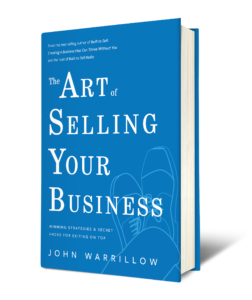
John Warrilow’s The Art of Selling Your Business
John Warrilow is the founder of The Value Builder System and an accomplished author. While not a business broker himself, Warrilow has gathered considerable knowledge and expertise on the industry. His previous book, Built to Sell, was listed as one of the best business books of 2011. In this article, we will explore some of the key points in Warrilow’s latest book, which is entitled The Art of Selling Your Business: Winning Strategies and Secret Hacks for Exiting on Top. This book was released on January 12th, 2021, and is proving to be invaluable for business owners.
Table of Contents:
Selling When the Time Is Right
One key focal point of the book is that business owners should skip trying to find the perfect “magical time” to sell their business. Additionally, Warrilow notes, “I make the strong recommendation in the book that the best time to sell your company is not during some mysterious macroeconomic environment. It is when someone is willing to buy it, and you get an offer. And that is because at that point, you’re in the position of strength.”
The DIY Approach
This book reinforces the fact that business owners truly need to work with an intermediary if they are to achieve optimal results. Warrilow even includes his six reasons why every business owner should hire a business broker or M&A advisor.
Many business owners think that they can simply handle selling their business on their own. But the simple fact is that business owners usually have no experience in selling a business. Add this to the fact that selling their business is likely to be the most important financial decision the business owner ever makes, and it quickly becomes clear that business owners are doing themselves a considerable disservice when they opt to handle everything on their own.
A Business Broker vs. A Lawyer
As Warrilow points out, oftentimes, business owners think that rather than working with a business broker or M&A advisor, they can turn to a trusted lawyer who has served them in the past. But this thinking is flawed when it comes to successfully selling a business. As Warrilow states, “a lawyer, almost by default, is going to be very conservative as everything exposes a lawyer to risk. And that is why using a traditional attorney is almost always a mistake.”
If you are planning to sell your business now or in the future, a book like Warrilow’s The Art of Selling Your Business: Winning Strategies and Secret Hacks for Exiting on Top can serve as a uniquely valuable tool in your toolbox.
Copyright: Business Brokerage Press, Inc.
The post John Warrilow’s The Art of Selling Your Business appeared first on Deal Studio – Automate, accelerate and elevate your deal making.

Turn to the Professionals for Best Results
There is a direct relationship between the asking price and the
amount of cash on the table at the time of the sale. Buyers and sellers alike should keep one fact in mind. Most businesses involve some level of seller financing. It is customary for both buyers and sellers to have concerns regarding this kind of financing; after all, sellers don’t want to take their businesses back from the buyer. Buyers want to generate enough money to help the business thrive and make a living. One proven way to ensure the successful sale of a business is to turn to the experts.
Table of Contents:
Screen out Window Shoppers
The simple and very established fact is that when you choose to work with the professionals, it can streamline the entire sales process. Business owners are typically very busy people. That means they don’t have time to waste with window shoppers. They also don’t want to divulge confidential information to parties that don’t possess the means to actually follow through with a successful sale.
Business brokers and M&A advisors know that most prospective buyers are just dreamers or will ultimately fail to qualify. When you work with the professionals, it means that you have a shield to protect you and your valuable time. Experienced brokers have a range of techniques that screen out unqualified candidates and match you with buyers who are the best fit.
Maintain Confidentiality
Anyone who has ever sold a business, or even contemplated selling a business, knows all too well that confidentiality is of the utmost importance. Sellers need to know that the information they reveal will not spill out all over the web. Brokers are experts maintaining confidentiality and impressing upon prospective buyers the tremendous importance of honoring the agreements they sign.
It is important to note that leaks regarding the sale of a business can cause a range of often unexpected problems. Key employees may get nervous about their future prospects and begin looking for a new job, competitors may begin attempting to poach employees, or customers and key suppliers may get nervous and turn to your competitors. In short, serious buyers and sellers alike benefit from maintaining confidentiality.
Matching the right seller with the right buyer is truly an art and a science. Many factors are involved ranging from financing to psychology. When the right match is made, then it is possible to move through the process of seller financing more quickly and with fewer roadblocks or complications. Working with a business broker or M&A advisor is the single most important step that any buyer or seller can make to help ensure that seller financing, and in fact the entire sales process, progresses as smoothly as possible.
Copyright:Business Brokerage Press, Inc.
The post Turn to the Professionals for Best Results appeared first on Deal Studio – Automate, accelerate and elevate your deal making.

How to Make Remote Teams Accountable
One of the many, many changes that COVID-19 has ushered in is the extreme uptick in people working remotely. Social distancing has made working from home a necessity for millions.
The technology that is allowing remote working to take place has matured greatly in the last decade. Today, it is possible for team members to work from virtually any location. Of course, as with most technologies, there is a potential downside. Accountability can become a significant challenge with remote workers. Of course, the more remote workers you have at a given time, the greater the potential challenges will be.
Many businesses are struggling with the phenomenon of remote working, as it is something new for them. Under normal circumstances, large numbers of employees working remotely simply wouldn’t happen. In a recent article, “The Right Way to Keep Your Remote Team Accountable,” author Elise Keith, Co-Founder and CEO of Lucid Meetings, explores the key steps businesses should take to help ensure that their employees stay on target while working from home.
Table of Contents:
Starting Slow
Keith believes that for remote working to be effective that there are 4 major mistakes that should be avoided. One of the biggest mistakes that employers, especially those unfamiliar with remote work, make is that they demand too much productivity right out of the gate.
She points out that remote teams can, in fact, be very productive and even outperform their in-office counterparts. Summed up another way, remote work can be extremely productive. Keith’s perspective is that businesses should “identify the highest priority tasks right now and relax the rest.” Business owners need to remember that they are not the only ones under stress. The simple and undeniable fact is that your employees are feeling the stress of COVID-19 as well.
Getting Good at Working Remotely
The second major mistake she points to is that people are assuming the current pandemic situation is temporary. Other crises will occur in the future, and it makes sense to be prepared. As she phrases it, why not “get good at working remotely?” Teams with good remote working skills are proving to be rather resilient right now.
Being Open to Technology
A third mistake she points out is businesses shouldn’t disallow the use of non-approved tools. In short, now is not the time to worry too much about what software tools people are using. Instead, she suggests creating an expedited process for the adoption of new tools. If your team finds a new tool that boosts productivity, you should consider buying it.
She astutely points out, “Software costs pale when compared to the costs of lost opportunity.” At the heart of this point is the fact that now, more than any time in decades, is the time to set aside restrictive thinking and become more open-minded and flexible. After all, your number one goal, and the number one goal of your clients, is to stay in business until the pandemic has passed.
Staying Flexible
Keith’s fourth mistake centers on management’s design to dictate hours and response times. Remote work is, by its nature, going to be more flexible. Trying to micromanage every move digitally is simply not a savvy move and will hurt morale.
Instead, she feels businesses should opt for having a daily meeting via phone or videoconference with the team. Additionally, she puts forth the idea of having a one-on-one meeting with every team member as well.
For many businesses and many situations, remote work may be the “only game in town.” Trying to carry on business as usual is only going to cause headaches for everyone. Remote work can be highly effective for you, especially when used correctly.
Copyright: Business Brokerage Press, Inc.
The post How to Make Remote Teams Accountable appeared first on Deal Studio – Automate, accelerate and elevate your deal making.

6 Tips and 90 Days to Protect Your Business
There can be no way around it, Inc. contributor Brian Hamilton’s April 2020 COVID-19 centered article, “6 Actions to Take in the Next 90 Days to Save Your Business,” isn’t pulling any punches. Hamilton, Founder of the Brian Hamilton Foundation, believes that the next 90-days could be make or break days for business owners looking to navigate the choppy waters of the COVID-19 pandemic. His latest Inc. article provides readers with 6 actions they should take now to survive the economic fallout of the COVID-19 pandemic.
Table of Contents:
Tip #1 Vigorously Control What You Can
Hamilton’s first tip is to “Vigorously control what you can. Vigorously ignore what you can’t control.” As Hamilton points out, you can’t control the economy; instead, you need to focus on what you can control. His view is that there has never been a more important time to focus, “More than ever, you’ll need to go to war with things within your control.” Now is the time to exercise control.
Tip #2 Guard Morale
During tough economic times, employee morale can be a real issue. This brings us to Hamilton’s second point, “guard employee morale.” Significant drops in employee morale can lead to serious problems with your business, which is exactly what you don’t want to see right now. Hamilton notes that you have to be the general that helps his or her troops rise above potential panic.
Tip #3 Preserve Cash
Hamilton’s third tip is to “preserve cash where you can.” He states, “Right now, your motto should be: Live to fight another day.” The pandemic means that you need to keep expenses down and watch every dollar. No one knows what the next few months, or the next couple of years, could have in store.
Tip #4 Be First in Line
“Be first in line,” is Hamilton’s fourth point. Hamilton wisely pushes business owners to be the first in line for government assistance. This is very good advice, as SBA and other funds are likely to be limited.
Tip #5 Get Back to the Basics
Fifth, Hamilton recommends, “Get back to the basics…starting with monomaniacal customer service.” As always, customers, whether existing or new, are the lifeblood of your business. You can’t afford to lose customers now and for this reason, you need to have a laser-like focus on customer service.
Tip #6 Pivot your Product or Service
Hamilton’s sixth tip is to “Pivot your product or service to new conditions.” Small changes to your business can open up new streams of revenue. Even if these streams of revenue are comparatively small, they could mean the difference between sink or swim! Try to step back and look at your business with fresh eyes and strive to find ways to offer something new to your customers. Whatever you offer should be based on your existing goods and services and not require a new, large expenditure.
The COVID-19 pandemic is obviously disruptive, but it won’t last forever. Hamilton’s advice of focusing intensely on the next 90 days is sound advice. You won’t regret looking for ways to safeguard your business for the next 3 months.
Copyright: Business Brokerage Press, Inc.
The post 6 Tips and 90 Days to Protect Your Business appeared first on Deal Studio – Automate, accelerate and elevate your deal making.

How to Connect During a Crisis
Small business owners are facing new challenges during this crisis. Communicating with customers requires more focus and depth than ever before. In Mat Zuker’s latest article for Forbes Magazine, he cites Jay Mandel who runs The Collective NYC, a marketing consulting team focusing on a customer’s experience, who underlines the importance of businesses to understand their mission statement and values in order to re-enforce marketing strategies.
Table of Contents:
Information Is Crucial
Each customer purveying your business’s website needs to understand your hours of operation, any limitations to service and what is being done to ensure cleanliness. Providing this information establishes to your customer your seriousness of precautions which will be appreciated during this time.
If your financial situation allows, focus on your employees, donate to charities or offer discounted or free products. By marketing this information, your brand’s scope will bolster with the customer as well.
Utilizing The Customer’s Time
Most customers are adhering to social distancing guidelines put forth by their state and the federal government. Now, more than ever, it is important to exhibit to your customers how your brand can be utilized beyond your brick and mortar. Zuker cites how universities are beginning to offer free online classes and telecommunication companies are offering two months of free service to low-income families; King Arthur flour is promoting its library of comfort food recipes (yes, please!). Thinking beyond your storefront to put your service or product into your customer’s virtual hands is important.
Remember To Entertain
By each passing day, customers are looking for new stimulation to help the time go by at home. Movie companies are making the best of the situation by sending theatrical releases to online streaming services. We don’t think it is necessary to always make your customers laugh, but it might be within your branding to aim for content geared towards warmth, humanity and empathy.
The metric for engaging your customers is changing; moving beyond views and shares to quality feedback or social impact on your community. Do not bite off more than you can chew. Cited in Zuker’s article, Social Media Today warns of virtue signaling; meaning declaring a set of values, but not following through on the actual deeds.
Also, this is a fantastic opportunity to consider your marketing strategies for when this crisis ends. What will your business look like once you are able to open the doors? How are you able to stay relevant with your competitors? These are all questions needing answers, but today we must do our best to accomplish what is in front of us.
Read Mat Zucker’s full article here: https://www.forbes.com/sites/matzucker/2020/04/01/content-in-a-crisiswhat-brands-can-deliver/
Copyright: Business Brokerage Press, Inc.
The post How to Connect During a Crisis appeared first on Deal Studio – Automate, accelerate and elevate your deal making.